 Dear Friend, Dear Friend,
Many of you were at Chabad last Shabbos when Rabbi Shais Taub spoke about a special daily study of Torah each day called CHITAS. Rabbi Taub mentioned how learning CHITAS is applicable for every Jew and its study contains many special qualities.
After his talk, it was suggested that we send out an email explaining the WHAT, HOW, AND WHY of Chitas. Thank you to the many who reminded us over the last few days to get this email out!
What is CHITAS?
ChiTaS (Hebrew: חת"ת) is an acronym for Chumash (the five books of Moses), Tehillim (Psalms), and Tanya (a key work of Chassidic philosophy by Rabbi Zalman of Liadi known as the Alter Rebbe). There is a custom within Chabad to study these works according to a yearly cycle, which is known colloquially as "doing ChiTaS.”
How does one study CHITAS?
CHUMASH The weekly Torah Portion is divided into 7 readings. Each day of the week one studies that portion associated with that day along with commentary of Rashi, the most fundamental commentary of the Torah. On Sunday, the first reading; On Monday, the second reading…until the 7th reading is studied on Shabbat.
TEHILIM The book of Psalms contains 150 chapters. These are divided by the days of the Hebrew month so that on every day one recites approximately 5-6 chapters of Psalms. Most editions of Tehilim have this division as so the Psalms available on Jewish sites online. Note that the Psalms portion of Chitas is more like a prayer than a study. Jews have always
used these words of King David in our prayers during both times of thanksgiving and distress.
TANYA Tanya, the fundamental text of Chabad Chassidic philosophy, is divided in a yearly cycle based upon the date on the Hebrew Calendar. The study consists of learning about a half a page of Tanya/day. You can read a short article on the basic theme of Tanya here.
These studies can all be done in any language. It is preferable to actually say the words audibly as you study.
Why the emphasis on studying Chitas right now?
The yearly cycle of Tanya starts all over today, the 19th of Kislev. (More on the specialty of today here) It is therefore a wonderful opportunity to begin studying Chitas!
What resources are available for study of Chitas?
The text of Chumash,Tehilim, and Tanya is available online here. There are also apps (both iphone and android) for these texts.
Daily video classes from Rabbi Josh Gordon (a clear and easy-to-understand teacher) on the Chumash and Tanya is available here. These are also available as MP3 downloads.
You can get an email with the daily Tanya Study here: (Go to Daily Study section of the subscriptions)
Like holding a text in your hands? If you’d be interested in purchasing a Hebrew/English Chumash with Rashi, Psalms, and Tanya, please email [email protected]. There's also a wonderful new booklet called "Chayenu" that can get mailed to your door with these daily study texts (mailing every 2 weeks) so you can have them in an light and easy-to-carry print edition wherever you go. More on Chayenu here.
What if there are days that I don’t understand the study?
That’s OK! Each time one studies Chitas, one understands things a little bit better. And even after learning Chitas for many years, one always sees things in a deeper manner. While some days (especially of Tanya) are more complex than others, the subject matter changes quickly and even on the difficult days there is always some message you can take. The video classes are also a great resource to turn to on the trickier days.
It’s also helpful to keep in mind that the holy words of these texts themselves have a purifying affect on the one who learns them, even when one does not fully understand them.
How much time does it take to study CHITAS
- Chumash- Depending on the length of the Parsha and how well it is studied, the Chumash can take 10-15 minutes.
- Psalms –About 5 Minutes
- Tanya – About 5-10 minutes
Some days you may have more time and study the texts in greater depth while other days may be a quicker read at the end of the day, but the beauty of CHITAS is this daily commitment to Torah Study.
What is so special about this specific study?
Education – The study of Chitas will help make one an educated Jew.
- Well-rounded knowledge of all 5 books of the Torah.
- Understanding of basic concepts in Jewish Mysticism.
- Familiarity with Psalms and the many verses from our prayers that come from it.
Jewish Unity
Hundreds of thousands of Jews study these exact texts every day. Think of the power of joining that spiritual energy. There is also that instant conversation starter when meeting another Jew who studies Chitas!
Connection to the Rebbe
The study of Chitas was especially dear to the Lubavitcher Rebbe, of righteous memory. When people would write to the Rebbe with requests for blessings or advice, the Rebbe would frequently ask the person whether or not they already study Chitas, stressing how its study is a source of tremendous blessings in our life. Studying Chitas deepens ones relationship to Chabad and their Rebbes.
A Mitzvah!
Torah study is not meant for just occasional classes or Shabbos. We are actually commanded to study Torah each day on our own, and the study of Chitas is a wonderful way to fulfill this Mitzah.
Bringing the Holiness of Torah to Every Day
Every day brings its challenges and ups and downs. The consistency of daily Torah study will elevate your entire day and fill your mind with Torah’s holy teachings. And you’ll be surprised to see how often that day’s teachings can relate to something in our life that day.
If you have any questions about the study of Chitas, feel free to email [email protected]
--
This Shabbos, davening at 909 Reedy Creek Rd. begins at 9:30 am with Torah Reading and discussion at 10:30 am and a kiddush at around 12:30pm. The kiddush is sponsored by the Keller family in honor of the yahrzeit of Larry’s father.
Good Shabbos,
Rabbi Yisroel and Rebbetzin Chana
|  Chabad
of Cary Learning Center
Chabad
of Cary Learning Center Between
the 3 days, more than 200 people had the opportunity to hear the thought-provoking words of Rabbi Shais Taub. We have received wonderful feedback and want to give a special thanks to the planning commitee, sponsors of the Shabbaton, and the community sponsors of Sunday's Lecture at Temple Beth Or. This uplifting weekend could not have happened with you!
Between
the 3 days, more than 200 people had the opportunity to hear the thought-provoking words of Rabbi Shais Taub. We have received wonderful feedback and want to give a special thanks to the planning commitee, sponsors of the Shabbaton, and the community sponsors of Sunday's Lecture at Temple Beth Or. This uplifting weekend could not have happened with you! Please help fill out kiddush sponsor calendar - Most weeks available!
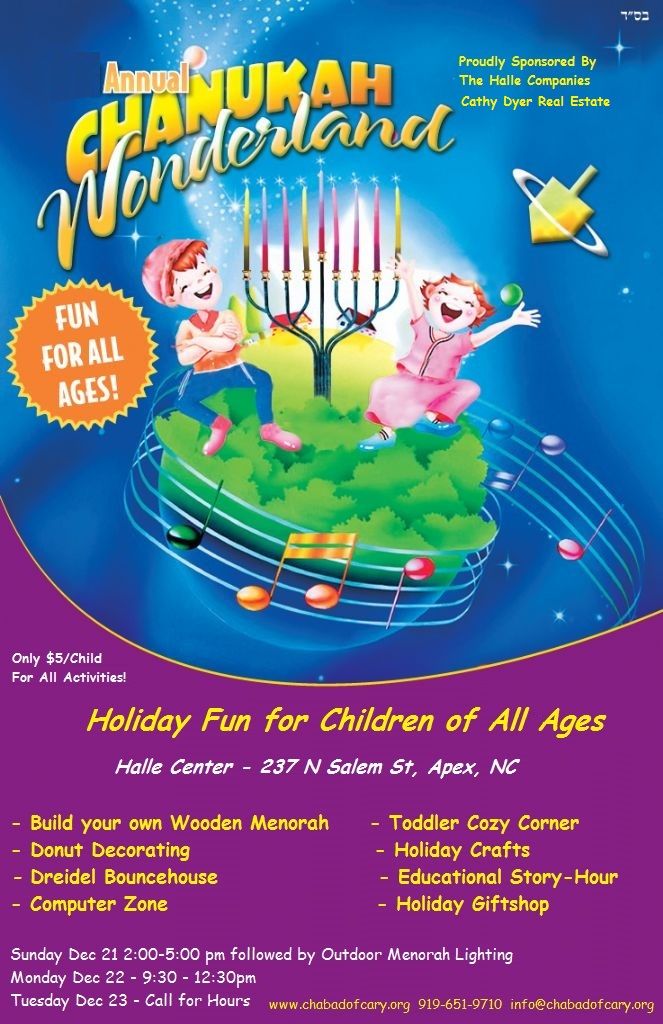 Please spread the word about this exciting holiday program!